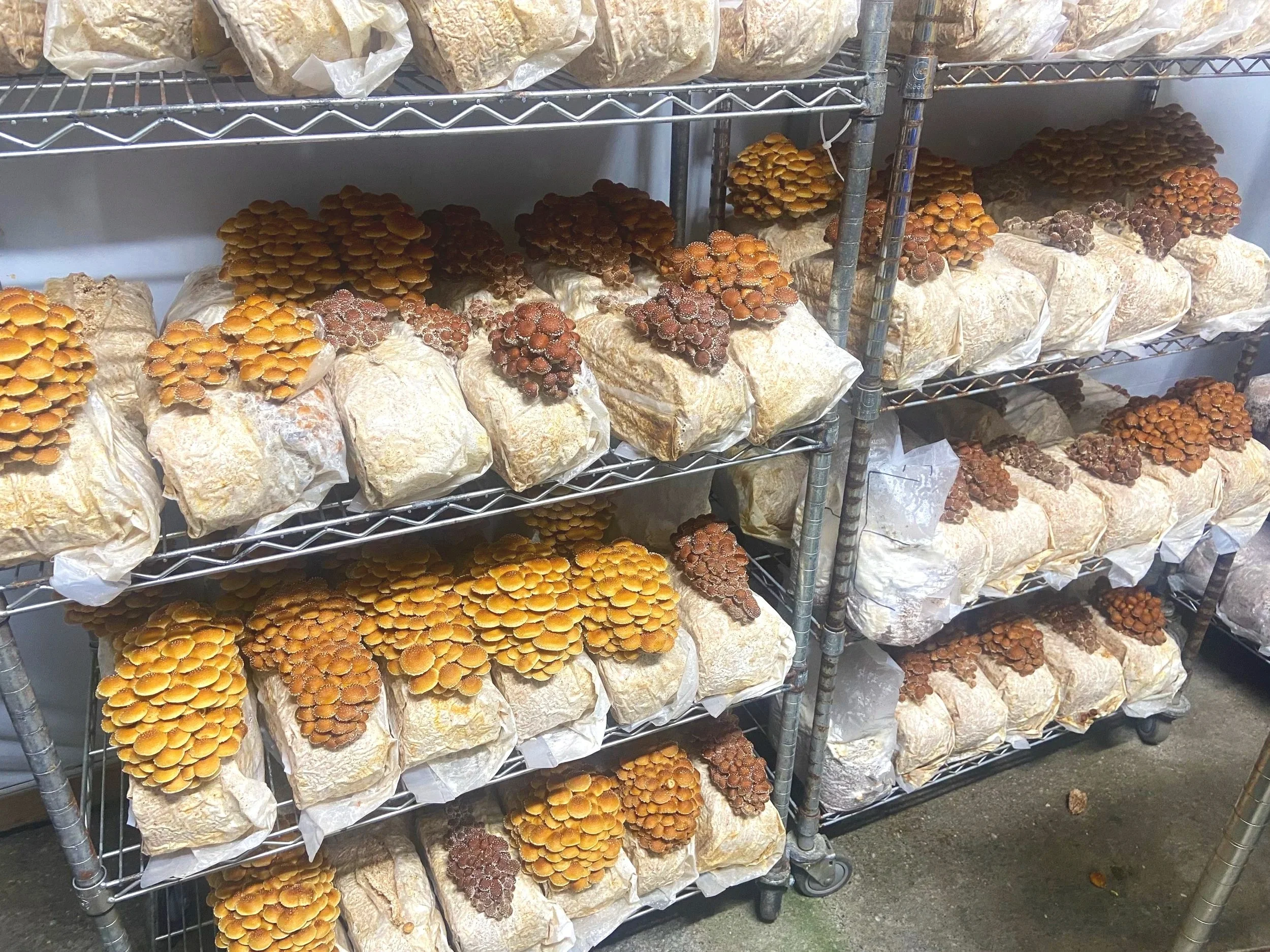
Here we’ve gone into more detail on the environmental conditions your grow kit will thrive in and many of the most common questions are answered below.
“Nothing is happening what do I do?!?!” Simple! But how we diagnose a fix is more complicated. Mushrooms grow best when there is balance between temperature, humidity, and fresh air. The first thing to check when a kit is not growing is temperature. Is it too cool or too warm? The closer to 60 degrees you get your kit the better it will grow. It can handle swings in temp much higher and down to freezing, but the sustained temperature should be around 60. It will set pins (baby mushrooms) at 58-63 degrees generally. If it is kept in sustained temps above 65 degrees it will become stressed and likely not produce mushrooms, or very few, and if kept below 55 degrees it will likely just sit there doing nothing and go into dormancy. If your house is a little too warm, try shocking it in your refrigerator and then putting it next to a window (that doesn’t get direct light). “Shocking” is used on small and large farms to encourage immediate mushroom production. Keep the Kit in the refrigerator for 6-24 hours, you do not need to water it while in the fridge, make sure the hole you cut to open the kit is completely covered so the mycelium doesn’t get dried out. When shocking this way keep in mind that your kit will add a couple of days to its grow cycle. Alternatively, if its too cold for you kit, it will remain dormant and no real damage is being done, find a spot that is a little warmer to get it started.
Let’s mention smell really quick. Your kit should not smell bad like its rotting or spoiled. The mycelium should be mostly bright white (for most kits) and a bit damp looking it should feel like a sponge that has just been wrung out. It should smell like damp wood, and some mycelium has a very sweet smell. If it smells bad, and I can’t emphasize enough that it is a very bad smell when spoiled, please reach out to us!
Another environmental condition that can cause problems is humidity. It is very important not to uncover the mycelium after you cut a hole in the bag. Simply cut along the line(s) drawn on the kit, and leave the plastic place covering the substrate, the mycelium will sense the oxygen and light and produce mushrooms at the section you opened. Leaving the mycelium covered will aid in the kit holding onto its moisture. Humidity can cause initiation problems (initiation = creating “baby” mushrooms), it can also be the cause of failed mushrooms after they have started growing. Do not spray the mycelium directly when you mist the kit, it is hydrophobic and will move away from the hole and definitely not produce any mushrooms! If you over spray the mushrooms you might notice misshaped mushrooms and brown streaks or spots on the stems which can lead to fully browning and rotting mushrooms. If your kit is always wet then you’ve been over misting. Just reduce your misting by half for a day or two. The kit will absorb the water or it will evaporate and you can start more regular misting again taking care that the kit should not look visibly wet for more than 20 minutes after you’ve misted. If mushrooms were damaged from over misting they will not recover. Eat any that are edible, and remove everything else. When you mist, spray a couple of times, once on top of the kit, on the plastic only, and another spray or two into the humidity tent you’ve setup for it. Misting does not mean drenching! If you are not misting enough, the section of the kit that is open will likely yellow, and feel dry to the touch. You might also notice that mushrooms are trying to grow from deeper in the kit, under the plastic. If under humidifying is occurring increase your misting frequency to fix this issue. It will help a lot to tape the original hole closed, flip the kit over, and cut a new hole if you’ve been under humidifying for awhile and not seeing any results from the kit.
Another big factor affecting your kit is Fresh Air or fresh air exchange. Mushrooms produce CO2 as they eat and digest substrate to produce mushrooms. They can produce enough CO2 to misshape mushrooms, or prevent them from growing all together. Make sure your humidity tent (if you’re using one, definitely use one) is loose around the bottom of the kit. As CO2 is heavier than air and will fall away if given somewhere to go. If using a shotgun or fruiting chamber, make sure you have holes along the bottom of the sides to allow air to move through chamber and CO2 out of the chamber. You do not want moving air, like a fan, blowing on the kit or next to it. The air will likely move the humidity off the kit, drying it out. As the mushrooms get bigger the humidity tent should be raised higher and higher to allow more and more fresh air to reach the mushrooms.
Light is an important factor in growing mushrooms. They need light to properly form, become the correct colors, and initiate and grow at the correct rate. Almost any light source will do. They like natural light, but never direct sunlight, a shady spot in your house is great. A small bulb in a basement or bathroom will suffice as well. But no light will result in inedible strangely shaped mushrooms.
There are other considerations when growing, each variety grows a little bit differently. Some take longer to initiate growth naturally. Some need cooler temperatures. Some can handle a wetter environment and some need drier. Some like a higher CO2 and some need atmospheric levels. There are fine tuning adjustments that can be made with each, and if you just can’t figure it out, then reach out through the contact page, we are happy to help.
Using a humidity tent is highly recommended. It keeps moisture trapped above the hole cut for mushroom growth for longer periods of time. Most of us don’t want to mist the kit constantly and a humidity tent is a great way to maintain a stable humid for longer periods of time or for when you aren’t around. Create one by putting forks or chopsticks in the 4 corners of the kit and drape a clear or mostly clear bag over the top of the utensils. You can stab the utensils straight into the substrate through the plastic or find another way to prop them up to hold the bag. And thats it! Budget humidity tent created. And just to state again, do not target the substrate when you mist the kit! They wont like that! Just mist the inside of the “tent” but leave the mycelium un disturbed.
Printable instructions can be found below:
Blue Oyster, Black Oyster, King Oyster, Sajor Caju instructions